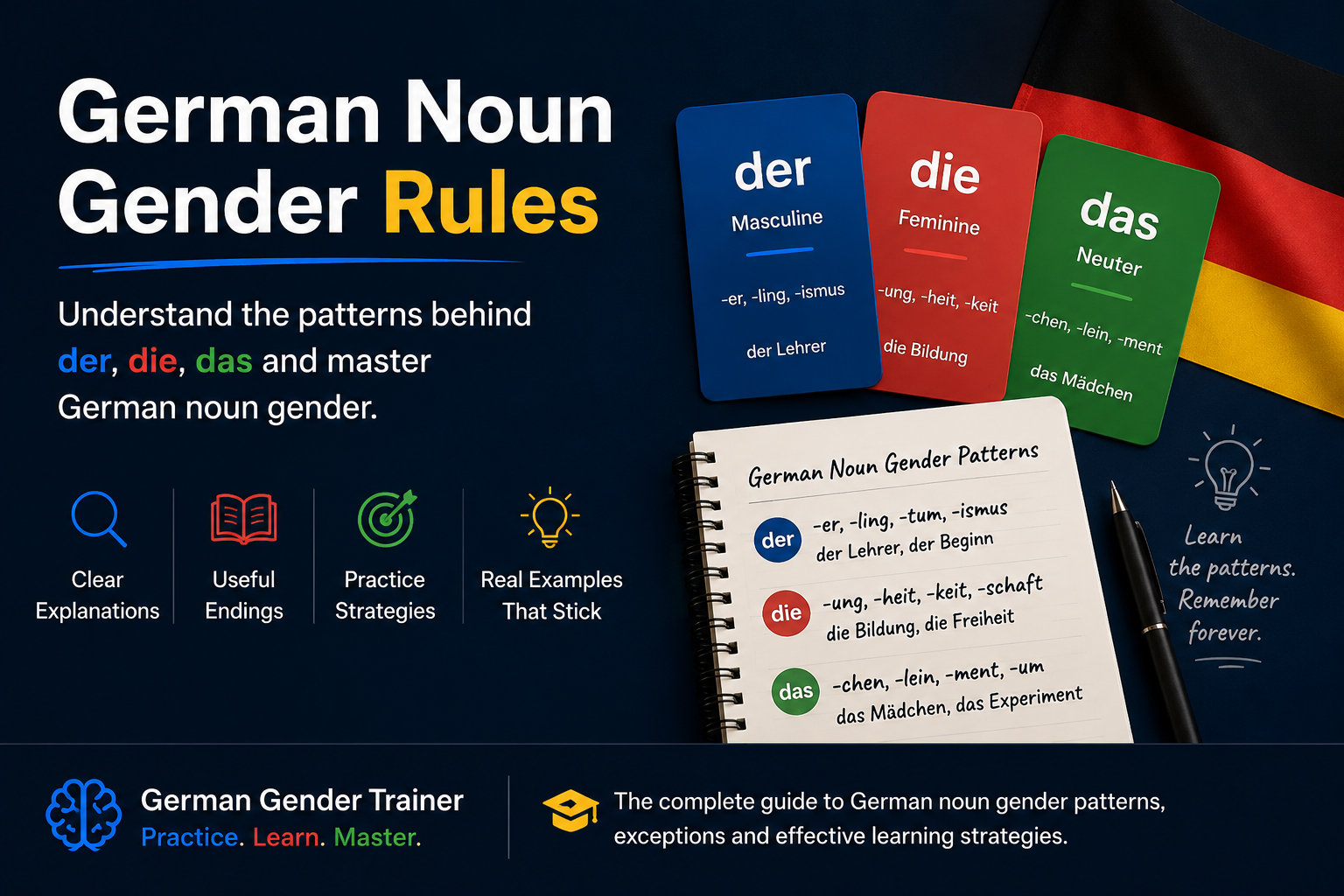
Why German noun gender is so difficult
For many learners, German noun gender is one of the biggest obstacles in the language. Every noun has a grammatical gender — der masculine, die feminine or das neuter — and unlike in many other languages, there is often no obvious connection between the meaning of a word and its gender.
Why is der Tisch table masculine?
Why is die Gabel fork feminine?
Why is das Messer knife neuter?
At first glance, the system looks completely random.
As a result, many learners try to memorize every noun together with its article. That certainly works, but it quickly becomes frustrating when your vocabulary grows from a few hundred words to several thousand.
Fortunately, German noun gender is not completely random.
Many nouns follow reliable patterns, especially those with common endings. Once you learn these patterns, you will often be able to make a good guess even when you encounter a word for the first time.
The challenge is knowing which patterns you can trust — and which nouns break the rules.
This guide focuses on the patterns that are genuinely useful in everyday learning, rather than trying to list hundreds of exceptions. If you understand the most reliable endings first, you will find that learning German noun gender becomes much easier.
The Most Reliable German Noun Endings
Although German noun gender sometimes seems unpredictable, many nouns follow patterns that are remarkably consistent. Learning these endings will not solve every case, but they will help you identify the correct article for thousands of common nouns.
Feminine: die
The following endings are almost always feminine:
| Ending | Example |
|---|---|
| -ung | die Zeitung |
| -heit | die Freiheit |
| -keit | die Möglichkeit |
| -schaft | die Freundschaft |
| -ion | die Nation |
| -tät | die Universität |
| -ik | die Musik |
| -ei | die Bäckerei |
Neuter: das
These endings are among the most reliable in German:
| Ending | Example |
|---|---|
| -chen | das Mädchen |
| -lein | das Fräulein |
Masculine: der
Although masculine endings are generally less consistent, a few are still highly reliable:
| Ending | Example |
|---|---|
| -ismus | der Kapitalismus |
| -ling | der Schmetterling |
Learning these endings first allows you to make educated guesses when you encounter unfamiliar words. Instead of relying on pure memorisation, you begin to recognise recurring patterns throughout the language.
Important Exceptions
German would be much easier if every noun followed the rules. Unfortunately, some of the most common words do not.
Here are a few classic examples:
| Noun | Gender |
|---|---|
| Name | der |
| Herz | das |
| Ende | das |
| Interesse | das |
| Ereignis | das |
| Gedanke | der |
| Erkenntnis | die |
These words are important because they appear frequently in everyday German and cannot easily be identified from their endings alone.
For this reason, the most effective learning strategy is to combine two approaches:
- Learn the reliable endings first.
- Practise the exceptions separately until they become familiar.
This combination is far more efficient than trying to memorise every noun individually.
How to Practise German Noun Gender
Reading about gender rules is useful, but recognising the patterns automatically takes practice.
The most effective approach is to work with a large variety of nouns while gradually learning which endings are reliable and which words are exceptions.
The German Gender Trainer has been designed around exactly this idea.
Instead of simply testing random vocabulary, it includes several training modes:
- Normal Mode for everyday practice with immediate feedback.
- Brutal Mode for testing yourself without seeing the correct answer after each word.
- Weak Area Training, which focuses on the article you struggle with most.
- Tricky Mode, which contains carefully selected nouns that are genuinely difficult because their gender cannot easily be guessed from their endings.
The goal is not simply to memorise thousands of articles. The goal is to recognise patterns first, learn the important exceptions, and gradually build an intuition for German noun gender.
If you would like to put these rules into practice immediately, try the German Gender Trainer and start training with thousands of German nouns organised by difficulty level.
Patterns That Are Useful — But Not Always Reliable
After learning the most reliable endings, you will probably notice another interesting phenomenon.
Some groups of German nouns seem to share the same gender, even though there is no official grammar rule behind them.
For example, many compound nouns ending in words such as -haus, -weg, -berg, -platz, -markt or -zug are masculine or neuter simply because the final part of the compound determines the gender.
Examples include:
- das Autohaus
- der Wanderweg
- der Marktplatz
- der Lastwagenzug
These patterns are useful and often help experienced learners make educated guesses.
However, unlike endings such as -ung or -heit, they are not guaranteed. They should be treated as helpful clues rather than fixed rules.
The same is true for many profession nouns. Words ending in -er, -iker, -ist or -eur are very often masculine:
- der Lehrer
- der Keramiker
- der Journalist
- der Ingenieur
Again, these patterns are useful shortcuts, but they should never replace learning the genuine grammatical rules.
As your vocabulary grows, you will gradually develop an intuition for these weaker patterns. Good German learners do not memorise thousands of isolated nouns — they learn to recognise both the strong rules and the weaker tendencies that occur throughout the language.